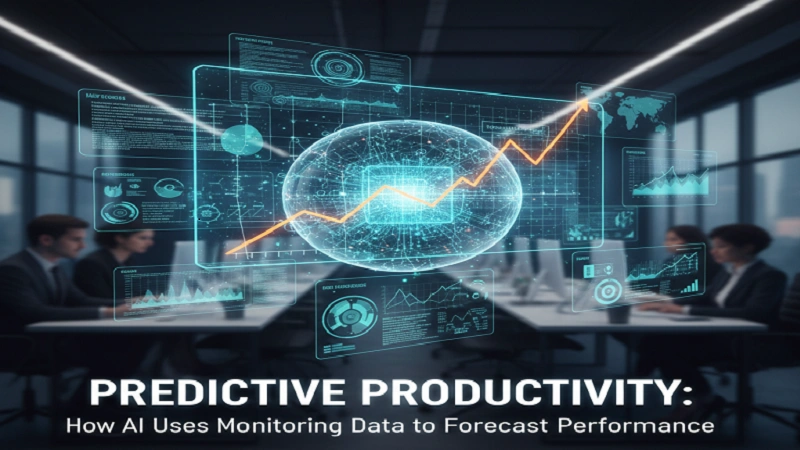
Employee monitoring software has evolved far beyond its early role as a simple activity tracker. In today’s digital workplace, especially in remote and hybrid environments, it has become a sophisticated analytical system capable not only of documenting work patterns but also of predicting future performance.
Companies increasingly rely on AI-powered insights to anticipate bottlenecks, prevent burnout, strengthen workflows, and build healthier, more sustainable work environments. The shift from monitoring to forecasting has reshaped how organizations understand productivity and how employees experience their daily workload.
From Tracking to Predicting: A New Intelligence Layer
Earlier generations of monitoring tools operated like digital observers, recording keystrokes, app usage, working hours, and general productivity patterns. They were informative, but they only captured the past. AI changed that dynamic. Instead of simply reporting what happened, modern systems can analyze behavior in real time and forecast what is likely to happen next. This predictive capacity profoundly changes workforce planning. Managers are no longer limited to reacting after problems surface; instead, they can foresee concerns such as declining focus, workload overload, delayed project milestones, or team bottlenecks long before they disrupt performance.
AI-generated predictions also help managers ask better questions. Instead of asking why a team is behind schedule, they can explore whether the team will fall behind in the near future and why that risk exists. Instead of waiting for burnout to appear, AI can flag early patterns indicating overwork, emotional fatigue, or a decline in engagement. This forward-looking approach empowers companies to respond strategically rather than defensively.
How AI Learns From Monitoring Data
Predictive models rely on large streams of behavioral and operational data. Employee monitoring software supplies a steady flow of information, but AI interprets it through complex patterns and correlations that humans would never uncover manually. Small but meaningful fluctuations — such as slight changes in focus time, increased task-switching, variations in meeting loads, or longer response intervals — gradually build a behavioral map of each employee and team.
Over time, AI learns what “normal” looks like for each role, department, and individual. It recognizes seasonal cycles in productivity, recurring project slowdowns, personal concentration rhythms, and the ways team interdependencies influence outcomes. It can detect when someone is performing at their best, when they’re overloaded, or when performance is shifting in a way that may require attention. The more data it analyzes, the more nuanced its predictions become, turning raw information into actionable intelligence.
Transforming Predictions Into Smarter Management
The power of predictive productivity lies in its practical application. When AI signals that an employee is gradually becoming overwhelmed — maybe taking fewer breaks, working longer hours, or showing inconsistent focus — managers can intervene early. Instead of framing conversations around discipline or performance issues, these discussions become supportive and preventive. A leader might suggest redistributing tasks, adjusting deadlines, or offering additional resources.
Predictive analytics also create more realistic project timelines. Instead of planning based on guesswork or optimistic assumptions, managers can rely on data-backed forecasts that reflect actual work patterns. This reduces unnecessary pressure and improves team morale. Additionally, when AI identifies skill gaps or recurring inefficiencies, it enables tailored coaching. Employees receive development plans grounded in their unique data rather than generic assessments, making professional growth more meaningful and achievable.
A significant advantage of predictive monitoring is that it reduces the need for micromanagement. Managers no longer need to constantly check on employees or monitor every step of a project. Instead, they can rely on AI to highlight only the areas that genuinely require attention. This frees leaders to focus on strategic work while allowing employees to operate with greater autonomy and trust.
A Better Experience for Employees
While predictive monitoring is often viewed as a management tool, it offers substantial benefits to employees as well. It promotes fairer assessments because evaluations are based on long-term patterns instead of subjective impressions. Employees who work steadily and consistently are recognized for their reliability, while those who contribute heavily during peak periods or in specialized tasks also receive accurate acknowledgment.
Workloads become more balanced because AI helps prevent uneven task distribution. When a department is approaching overload, AI can flag the issue early enough to adjust assignments before stress escalates. Employees also gain more predictable workdays, as early warnings about potential delays or bottlenecks help teams prepare and distribute responsibilities more intelligently. The overall effect is a calmer, more structured daily rhythm that minimizes frustration and unexpected chaos.
Perhaps most importantly, predictive insights help employees feel supported rather than scrutinized. When the purpose of monitoring is clearly communicated — especially when paired with transparent policies and access to personal insights — employees see the system as a tool that safeguards their well-being. AI becomes a partner in maintaining healthy work habits instead of a mechanism that watches for mistakes.
Why Predictions Still Need Human Interpretation
Despite their sophistication, predictive models cannot replace genuine human understanding. AI cannot interpret personal context, emotional nuance, or the specific circumstances surrounding an employee’s life or work challenges. A sudden drop in productivity might reflect a stressful project, but it could also signal health issues, family responsibilities, or creative problem-solving that temporarily slows output.
That’s why predictive insights must always be used as conversation starters, not conclusions. Human judgment, empathy, and open communication remain essential. The most effective managers combine AI-generated predictions with regular check-ins, transparent dialogue, and thoughtful interpretation. Technology provides clarity, but people provide meaning.
Ethics and Responsibility in Predictive Monitoring
The rise of predictive productivity has sparked important discussions about ethics and responsible data use. Companies must commit to transparent communication, explaining what data is collected, how predictions are generated, and how insights will be used. Employees should be able to view their own data and understand how it influences evaluations or workload decisions. Safeguards must be in place to prevent algorithmic bias and ensure that predictions support improvement rather than punitive measures.
When these practices are followed, predictive monitoring becomes a trusted system rather than a source of anxiety. Employees feel that the technology works for them — not against them.
A Glimpse Into the Future
The next evolution of employee monitoring software will bring even more personalization. AI will likely recommend ideal working hours for each individual, suggest when someone should take time off to prevent burnout, and offer tailored productivity coaching based on personal concentration rhythms. Teams may receive dynamic workflow suggestions designed to optimize collaboration, reduce friction, and increase output without sacrificing well-being.
Rather than simply tracking work, these systems will help create a smarter, healthier, more adaptive work environment where productivity grows naturally because the conditions for good work are consistently maintained.